
Author Guide
Download the English Article Submission Template Here [AIJS Template]
The Title of the Manuscript
First Author[1]*, Second Author2, Third Author3
1Department, College, University, City, Country
2Department, College, University, City, Country
3Department, College, University, City, Country
Abstract
The first important part of your paper is its title. The title can be either descriptive or, more attractively, declarative. It should be interesting, and intelligible that conveys the importance of your work. To be effective, a title should be about six words or less. An equally important part of the paper is the Abstract section. The abstract serves as a concise yet comprehensive summary of your entire paper, presented in a single paragraph of 200-250 words using Time New Roman font, size 10-pt, with single-line spacing. This crucial element should encompass an overview of the topic, identify the research gap, state the objectives, describe research methods, highlight key results, and discuss the implications of the study. Abstracts between 100 to 150 words are generally well received.
Keywords: Carefully select an appropriate list of five keywords that represents the real content of your paper. This will help the readers find your paper more easily as they search through the database search engine.
* Email address of the Corresponding Author
Introduction
This section introduces the article and outlines its structure. The introduction should clearly state the article's purpose, provide a literature review, and highlight the research's significant contribution. It comprises approximately 15–20% of the total article length.
Authors should provide a comprehensive background and literature review to contextualize existing solutions, highlight previous studies' limitations, and demonstrate the research's novelty. The review should be organized thematically rather than by individual authors, presenting a critical analysis of the existing literature rather than a simple description of prior work. The introduction should conclude by explicitly stating the research gaps, the novelty of the study, its objectives, and the significance of the findings. Phrases such as “Few researchers have focused on...”, “There have been limited studies concerning...”, or “This research aims to...” may be used to highlight the specific gap being addressed.
For original research papers, the Afghanistan International Journal of Sciences follows the IMRaD structure (Introduction, Methods, Results, and Discussion). The Introduction must serve as the conceptual foundation of the study by defining the research problem, summarizing relevant literature, and providing a logical lead-in to the study’s objectives and hypotheses.
For systematic reviews and meta-analyses, the Introduction should align with the PRISMA (Preferred Reporting Items for Systematic Reviews and Meta-Analyses) guidelines. Authors must outline the review’s purpose, relevance, and scope, clearly distinguishing it from previous work. Systematic reviews must be evidence-based, well-scoped, and justified with a transparent rationale. Importantly, the journal does not preferably process narrative literature reviews, as they lack the methodological rigor and reproducibility required for scientific validity.
In all cases, the Introduction should be informative, coherent, and analytical, enabling readers to understand the scholarly context and the necessity of the research. A well-structured Introduction not only provides a roadmap for the rest of the paper but also highlights how the study contributes to advancing knowledge in its respective field.
Manuscripts should be formatted in Microsoft Word (DOC, DOCX, or RTF), using 12-point Times New Roman font, with 2.5 cm margins on all sides, 1.15 line spacing, and on A4 paper. The recommended length is 4,500–7,000 words, excluding references and appendices. Authors are expected to submit thoroughly proofread material.
For citations and references, authors should use Reference Management Software such as Zotero or Mendeley, following the APA 7th Edition citation style. It is advisable to use grammar-checking tools such as Grammarly to ensure spelling and grammatical accuracy prior to submission.
End your manuscript with specifically listing the research objectives and or research questions and or research hypothesis.
Research Methodology
The Materials and Methods section should offer a clear, concise, and replicable description of how the study was conducted. It is a critical component of scientific transparency and must include sufficient detail to allow independent replication or critical evaluation of the procedures. Authors should describe the research design, the characteristics and selection process of participants, samples, or data sources, as well as the instruments, tools, or technologies used. Procedures for data collection and the statistical or analytical methods applied must be clearly explained. If the study follows established or previously published methods, relevant references must be provided, and only modifications should be described in detail. Units of measurement should conform to the International System of Units (SI), and any ethical considerations or approvals—such as from an institutional review board—must be noted where applicable.
For original research articles, the Journal of Natural Science Review follows the IMRaD model (Introduction, Methods, Results, and Discussion), and the Materials and Methods section must strictly align with this structure. Authors are encouraged to subdivide the section using clear headings such as Study Area, Experimental Design, Treatments, Sampling Techniques, Data Collection, and Statistical Analysis. The description should be written in the past tense and limited to methods relevant to achieving the research objectives. This section typically accounts for 10–15% of the total manuscript length.
For systematic reviews and meta-analyses, the journal requires adherence to the PRISMA (Preferred Reporting Items for Systematic Reviews and Meta-Analyses) guidelines. The Methods section in such submissions must include a detailed account of the review protocol, including databases searched, search terms or strategies, eligibility criteria (inclusion and exclusion), screening and selection processes, data extraction methods, and the approach to synthesis or meta-analysis. Flow diagrams and PRISMA checklists are required to ensure methodological transparency and completeness. The journal does not accept narrative literature reviews, as these lack the methodological rigor and reproducibility required for peer-reviewed scientific analysis.
The Materials and Methods section plays a foundational role in establishing the credibility of the research. Manuscripts that fail to provide a clear, structured, and replicable methodology may be returned to authors for revision or rejected without external review.
Findings
The Findings section presents the results of the data analysis, addressing the research questions. It should comprise 20-30% of the total article length. Highlight any differences between your results and those of previous studies.
Present findings objectively and factually, without personal opinion. Include relevant numbers, tables, and figures, numbered consecutively (e.g., Table 1, Figure 1). Place table titles above the tables and figure captions below the figures, using 10-point Corbel font.
Provide detailed explanations for each table and figure. Use APA style for in-text citations, including author's last name and year. For direct quotations, include page numbers. When citing multiple references, list them alphabetically. For sources with up to five authors, list all names in the first citation, then use "et al." for subsequent mentions.
Formatting Headings in APA
Page Setup and Fonts
Your paper must use a page size corresponding to A4 which is 210 mm (8.27") wide and 297 mm (11.69") long. Top, bottom, left, and right margins should be 2.5 cm. Use Times New Roman font throughout the manuscript, in the sizes and styles shown in Table 1.
Table 1: Recommended fonts and sizes.
|
Style name |
Brief description |
|
Article Title |
14 pt, bold |
|
Author Name |
12 pt, bold |
|
Author Affiliation |
10 pt, italic |
|
Abstract |
10 pt |
|
Keywords |
10 pt |
|
Heading 1 |
12 Pt, bold |
|
Heading 2 |
12 pt, italic |
|
Heading 3 |
11 pt, italic |
|
Body Text |
12 pt |
|
Figure caption |
10 pt |
|
Table caption and body text |
10 pt |
|
References Text |
11 pt |
Abbreviations and Acronyms
In technical writing there are generally three types of abbreviations:
- An abbreviation that is first introduced in the text. This abbreviation is placed within parentheses directly following its first occurrence of the spelled-out words in the text. Mostly, they are the initials of the words written in capital letters (e.g. University of Baghdad (UoB)). Thereafter, this abbreviation can be used instead of the words throughout the rest of the paper. However, try not to invent abbreviations just to save space, use words instead and make your paper more readable.
- An abbreviation that is commonly known in the field of research (e.g. SNR for signal-to-noise-ratio). However, some of these abbreviations are slangs and should be avoided in writing, like lab for laboratory.
- Acronyms are special case of abbreviations when these abbreviations are pronounced as words such as NATO.
Abbreviations and acronyms are written either in capital letters or small letters depending on the way it has been originated; try to check a dictionary to be more certain.
Equations
We prefer to start this section by strongly advising you to use the built-in functions of your word processor to create equations. This will increase the legibility of your writing.
There are many ways you must follow in writing equations. Most of them are related to the grammar rules of English because equation should be regarded as being part of the text and punctuated accordingly. For short and uncomplicated equations, they can be treated as nouns in sentences:
If an object starts with a velocity at a time and at a later time has a velocity of , then its change in velocity is and .
Longer and more complicated equations should be written on a separate line, centered, and numbered consecutively beginning with (1) along the right margin, to the end of the paper. This number is used when referring to the equation throughout the text.
The duration of the heating cycle can be approximated by the equation
, (1)
where cycle time, ; resistance, Ω and = capacitance, .
Within the text, the reference to these equations is an abbreviation to the word “Equation” written as “Eq. (1)”. However, if you begin your sentence with a reference to an equation, the word must be spelled out fully.
As a final note, all variables/symbols mentioned in the equation and not previously defined should be listed (use semicolon to separate them) and explained, most commonly, in the text following it starting with the word “where” or “with” but do not capitalize or indent these two words. As an example, refer to Eq. (1).
Tables and Figures
In general, ‘Results’ section is where you are going to share your data with the readers using tables and figures, and it is perhaps the most important part when writing a research paper. Tables and figures should be produced in clear and effective way that demand careful planning that, sometimes, starts at the manuscript writing stage itself. When presenting tables and figures, it is important to avoid repeating the information which is already elaborated in text and should not be again given in tables or figures. This makes the paper unnecessarily lengthy and tables and figures, meaningless. Their placement should be at the center of the page and properly referenced and numbered consecutively, in the order in which they are mentioned in the text. Often, readers review tables and figures before reading the text, therefore, each of which should stand alone in a complete and informative manner.
Tables
Tables should be well structured and organized to attract the interest of readers in your work as they can easily be understood without referring to the text. They are often used for reporting extensive numerical data that have been, for example, obtained from conducting multiple experiments and cannot be presented in a graph. These tables are called quantitative tables, as shown in Table 2 which is excerpted from its original work in [1]. Tables are easy to create using simple programs such as Microsoft Word's table feature, i.e., they should NOT be in picture format. All tables share common elements including the caption, column titles, and body.
- Table title (caption) should be brief, clear, and descriptive but sufficiently explained the data included, as such they can be lengthy or short depending on the topic of the paper. Captions for tables are placed above the table (center aligned).
- Column titles (headings) normally used to simplify the table and describing the material below it that help the reader to quickly understand what the table is presenting. Column headings are centered over the columns of numerical data (forming a T-shape). If there are unites that must be stated, then add them in the first row below the column headings.
- The body of the table is usually a group of rows and columns of data. Center-align this data within the body of the table and make it neat and clear by giving plenty of space. Sometimes things seem complicated if the rows and columns need to be grouped or subdivided, in this case, there should be a row or column subheadings.
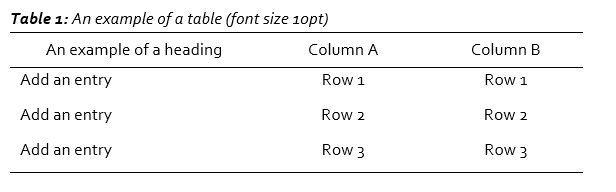
Place titles of Tables preceding them and of Figures after the figures using Corbel font size 10, centered.
It is also worth mentioning that tables are also a powerful way of showing textual information such as specifications or comparisons. These tables are called qualitative tables, as can be seen in Table 1.
Figures
Figures are used liberally to illustrate thoughts, generally, as a graph, a photograph, or a chart. Photographs in technical papers are mostly of apparatuses used during experiments, however, use it if it really adds something to your explanation; otherwise, schematic drawing serves better. On the other hand, charts and graphs are just another way of presenting the same data that is presented in tables, although in a more pictorial and interesting way. At the same time, however, you get less detail or less precision in a chart or diagram than you do in the table. When using figures, there are several requirements to keep in mind:
- Graphs usually has x and y axes that must be associated with labels. Be sure to add sufficient information into the label but try not to get too much into it, for example, Average Speed (cm/sec).
- For all types of figures, you must add a figure title (caption) presented and numbered in the same way of table caption, except for the position of the figure caption that is placed below the figure (center aligned).
- Figures, in general, should be in high quality, and the preferred figure format is TIFF. The TIFF should be saved at a minimum resolution of 500 dpi (dots per inch) at final size. You can use 600 dpi if you need more resolution but remember it will create a much bigger file size. You can change the scaling if you need to. TIFF file, especially those containing color, should be large. We encourage authors to provide color figures. Figure legends should be related to figures, and they should be placed outside the figures, NOT inside. The size of all letters and symbols should be appropriately fitting figures. As an example of TIFF files, you can refer to Figures 1 and 2.
Figure -2 This figure depicts a high-resolution color image of a still from an animation about brain cells as an examples of TIFF files (a) Frame 1 (b) Frame 2
Discussion
The Discussion section should comprise 20-30% of the total article length. It offers interpretation and explains the significance of the study results, emphasizing theoretical or practical implications.
In addition to interpreting the findings of the study, compare and contrast the findings with those from previous studies and relevant theories. Address the following points:
- How do your results relate to the original research questions or objectives?
- Provide scientific interpretations for each finding, supported by valid analysis.
- Compare your results with those reported by other researchers, noting consistencies and differences.
The discussion should offer a comprehensive analysis of the findings' implications and their place within the broader research context.
Conclusion
This final section encapsulates the paper's key points and restates the primary findings. It should succinctly present the most significant propositions of the research, along with the author's perspective on the practical implications of the results. Elucidate how your work advances the field's current state of knowledge. A well-crafted conclusion is crucial for reviewers and readers to assess the work's merit and publish ability. Avoid simply reiterating the Abstract or listing findings. Instead, provide a clear scientific justification for your research, indicating potential applications and extensions. You may also propose future research directions and highlight ongoing studies.
Acknowledgements
It is the proper section in the paper to thank all the people who helped you most in carrying out your research work. For example, a supervisor, a sponsoring institution, a funding body, and your colleagues or other researchers who have helped in the preparation and agreed to share with you their unpublished results. Acknowledge people’s help and contribution will ensure the integrity of your research. It is also worth remembering that the style of writing the acknowledgement should be in a professional manner, so try to avoid any emotional or personal thoughts.
Authors Contributions
Clearly specify each author’s contributions, avoiding vague statements, and ensure all authors are listed with roles reflecting their involvement. Note equal contributions if applicable (e.g., "A.B. and C.D. contributed equally"). Indicate that all authors reviewed and approved the final manuscript
Sample:
- Ahmad and Khalid conceptualized and supervised the study.
- Ali investigated and analyzed data.
- Javid wrote the manuscript with input from all authors.
- All authors reviewed and approved the final version.
References
The References section lists all sources cited within the article. Conversely, every source listed in the References should be cited in the article's body. Prioritize recent sources, preferably published within the last five years. Primary sources should predominantly consist of journal articles, conference proceedings, and research reports, including theses and dissertations, accessible online (include permalink/DOI). At least 80% of the total references should be derived from journal articles (primary sources). Verify each reference against its original source (author name, year, volume, issue, permalink/DOI). Use other articles from the same journal as formatting guides. Present references alphabetically and chronologically, using 12-point Corbel font, justified alignment, single line spacing, and hanging indents. Examples of proper formatting follow:
Abbasi, T., & Abbasi, S. A. (2011). Water quality indices based on bioassessment: The biotic index. Journal of Water and Health, 9(2), 330–348. https://doi.org/10.2166/wh.2011.133
Alfarra, A., Kemp-Benedict, E., Höltz, H., Sader, N., & Sonneveld, B. (2012). Modeling water supply and demand for effective water management allocation in the Jordan Valley. Journal of Agricultural Science 5(1), 40–60.
Azimi, A., Azari, A., Rezakazemi, M., & Ansarpour, M. (2017). Removal of heavy metals from industrial wastewaters: a review. ChemBioEng Reviews, 4(1), 37–59. https://doi.org/10.1002/cben.201600010
Joo, S. H., & Tansel, B. (2015). Novel technologies for reverse osmosis concentrate treatment: A review. Journal of Environmental Management, 150, 322–335. https://doi.org/10.1016/j.jenvman.2014.10.027
Nazari-Sharabian, M., Aghababaei, M., Karakouzian, M., & Karami, M. (2020). Water on Mars—a literature review. Galaxies, 8(2), 40.https://doi.org/10.3390/galaxies8020040
Postel, S. L., Daily, G. C., & Ehrlich, P. R. (1996). Human appropriation of renewable fresh water. Science, 271(5250), 785–788. https://doi.org/10.1126/science.271.5250.785
Kegel, S. F., Rietman, B. M., & Verliefde, A. R. D. (2010). Reverse osmosis followed by activated carbon filtration for efficient removal of organic micropollutants from river bank filtrate. Water Science and Technology, 61(10), 2603–2610. https://doi.org/10.2166/wst.2010.166